
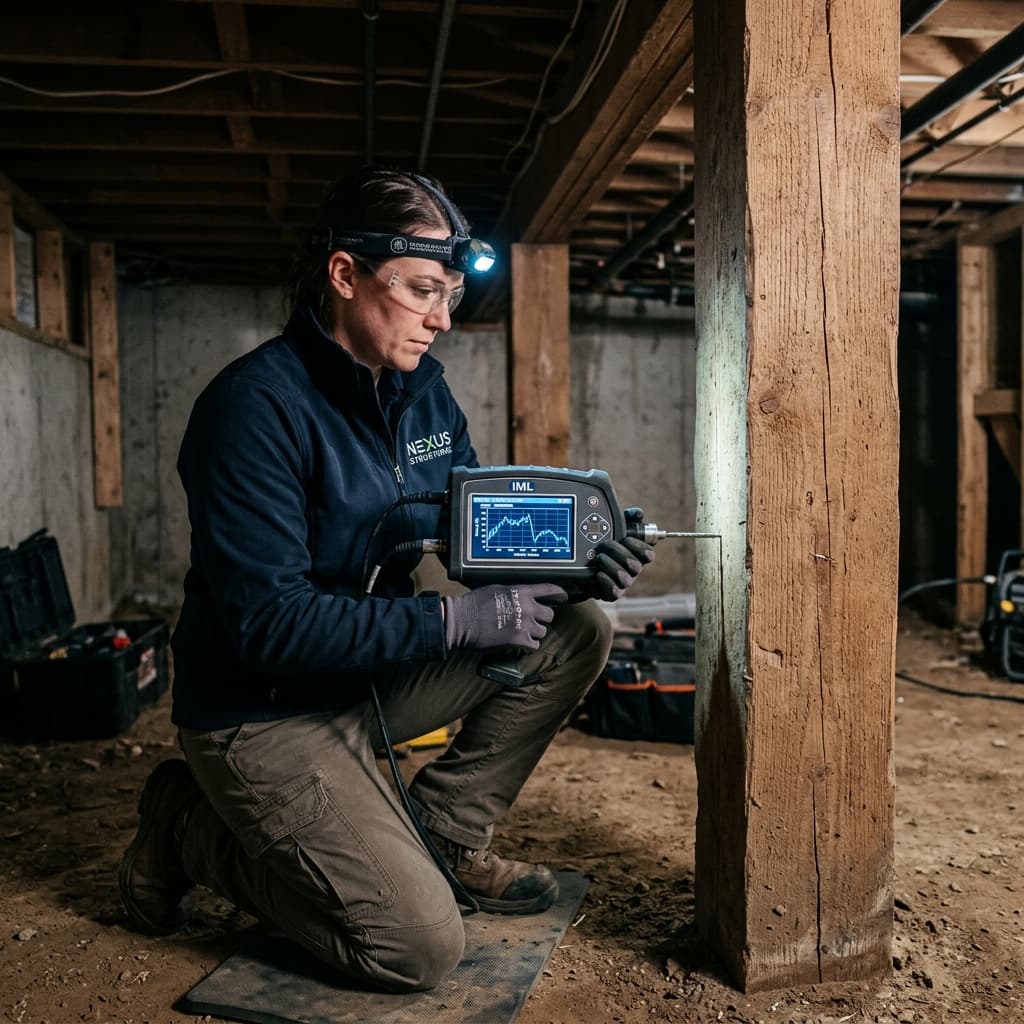
Understand how PiersPro uses Resistograph micro-needle diagnostics to test wood density non-destructively. Learn how we find hidden dry rot and termite damage inside structural timbers.
Table of Contents
When evaluating the safety and stability of a residential structure, inspectors must check the condition of its primary load-bearing wood components—such as posts, columns, girders, and mudsills. Traditional inspection methods often rely on visual checks or physical probing with a screwdriver. While these methods are useful for surface issues, they are unable to detect internal decay, hollow cavities, or termite nesting hidden deep inside thick structural timbers.
To solve this challenge, PiersPro utilizes state-of-the-art Resistograph testing. This advanced technology provides a non-invasive wood inspection that reveals the internal condition of structural lumber without causing any damage to the wood or the home.
At PiersPro, operating under California General Contractor License #1110475, we believe in using technology to deliver honest, accurate diagnostics. In this guide, we will explain how resistograph wood testing works, how we interpret density graphs, and how this data prevents unnecessary demolition and saves you money.
How Does a Resistograph Work?
A Resistograph is a handheld diagnostic device equipped with a very thin, 3-millimeter steel micro-needle.
* The Process: We place the device against the wood member and activate the micro-drill. The needle is driven into the timber at a constant, controlled speed.
* Measuring Resistance: As the needle drills through the wood, it encounters mechanical resistance from the wood fibers. The device measures this resistance in real time.
* Graphing Density: The resistance data is transmitted to a digital graph that maps the internal density of the timber along the path of the needle.
Because the needle is only 3 millimeters in diameter, the inspection is completely non-destructive. The micro-hole left behind is self-sealing and does not impact the structural integrity of the timber.
Interpreting Resistograph Density Graphs
The Resistograph outputs a continuous graph showing resistance levels. Our structural inspectors interpret these graphs to diagnose wood health:
* Dense, Healthy Wood: Shows a series of high, tightly packed peaks. These peaks correspond to the growth rings of the tree, indicating solid timber with high compressive strength.
* Early Decay (Dry Rot): Shows a noticeable drop in the height of the peaks, indicating that fungal growth is softening the cellulose fibers and weakening the wood.
* Cavities and Hollows: Shows a flat line with near-zero resistance. This reveals internal voids, hollowed-out centers from drywood termites, or advanced decay where the wood has crumbled.
By knowing exactly where the decay begins and ends, we can design targeted structural wood repairs rather than recommending full, expensive girder replacements.
---
Mid-Content Call to Action
Do you suspect hidden wood rot or termite damage in your home's framing?
Don't guess about your home's safety. PiersPro offers a detailed $99 Instrumental Diagnostic featuring Resistograph testing and moisture mapping. If you proceed with repairs, the $99 diagnostic fee is fully credited to your contract.
Schedule a Resistograph Inspection or call (213) 583-6669 to speak with our engineering team.
---
Resistograph Testing vs. Traditional Wood Inspection
| Diagnostic Metric | Resistograph Testing | Screwdriver Probing | Core Drill Testing |
|---|---|---|---|
| Inspection Depth | Up to 20 inches deep | Surface level only (1/2" max) | Full depth (destroys core sample) |
| Damage to Wood | Non-destructive (3mm micro-hole) | Minor surface indentations | Destructive (leaves 1/2" to 1" hole) |
| Detection of Voids | Extremely precise (maps exact boundaries) | Cannot detect internal cavities | Detects voids but weakens the beam |
| E-E-A-T Evidence | Digital density graph report | Inspector's visual opinion | Physical wood core sample |
| Efficiency | Takes 2 to 3 minutes per test | Fast but highly subjective | Slow, requires patching and plugging |
Cost Savings and Engineering Accuracy
Using Resistograph diagnostics allows PiersPro to save homeowners thousands of dollars by preventing over-engineering and unnecessary material replacement:
* Targeted Sistering: If the Resistograph reveals that only a 4-foot section of a 15-foot girder has internal rot, we can install localized shoring and sister a new wood member to bridge the gap, rather than replacing the entire girder.
* Pest Mitigation: If we identify hollow cavities from termites, we can coordinate with pest control to target the exact nesting site, saving on chemical application and labor.
Operating under a strict "No-Upsell" policy, we use this diagnostic data to justify every repair estimate. If our Resistograph scans show that your wood beams are solid and stable, we will give you a clean report and won't recommend any work. You can review photos of our actual crawl space inspections and structural repairs in the Projects section of our website.
Frequently Asked Questions (FAQ)
Q1: Does drilling the Resistograph needle weaken the wood?
A1: No. The micro-needle is only 3 millimeters in diameter (about the size of a standard paperclip wire). The wood fibers seal back together around the tiny hole, ensuring there is zero impact on the load-bearing capacity of the timber.
Q2: What wood species can be tested with a Resistograph?
A2: The device is calibrated to test all common residential wood framing species used in California, including Douglas Fir, redwood, Southern Yellow Pine, and engineered timbers like Laminated Veneer Lumber (LVL).
Q3: Can the Resistograph detect termite activity?
A3: It detects the structural consequences of termite activity. When termites eat galleries inside a beam, it creates hollow voids. The Resistograph maps these voids as drops in mechanical resistance.
Q4: Is a Resistograph inspection required by city codes?
A4: No, it is not mandated by standard building codes for standard single-family homes. However, structural engineers and city building departments (LADBS/OC) highly value Resistograph density reports when deciding whether a historic structural member must be replaced or can be repaired.
Schedule Your Diagnostic Inspection Today
Eliminate the guesswork and protect your home's structural framing with advanced, non-destructive diagnostics.
Contact PiersPro today. Call us at (213) 583-6669 or book your diagnostic online to schedule an inspection.