
A comprehensive guide to repairing and reinforcing load-bearing wood beams and columns in Southern California homes. Learn about dry rot detection, epoxy injection, carbon fiber reinforcement, and professional repair costs.
Table of Contents
- Common Causes of Load-Bearing Wood Beam Damage in SoCal
- High-Tech Diagnostics: The Resistograph Wood Test
- Modern Techniques for Structural Wood Repair
- Typical Repair Methods and Cost Comparison
- The PiersPro Promise: Integrity in Engineering
- Frequently Asked Questions (FAQ)
- Protect Your Structure: Schedule a Diagnostic
In Southern California homes, structural wood framing is the backbone of residential stability. Whether it is a support column in the crawl space, a main floor joist, or a heavy girder supporting the roof, these wooden elements bear the massive loads of your entire house. However, wood is an organic material, making it vulnerable to moisture, dry rot, termites, and seismic movement. When a load-bearing wood member is compromised, it threatens the structural integrity of the entire building.
Delaying load bearing wood beam repair can lead to sagging floors, cracked drywall, binding doors, and in severe cases, structural collapse. At PiersPro, we specialize in advanced, non-destructive diagnostics and permanent engineering solutions for compromised wood framing. In this complete guide, we will explore the common causes of wood damage, how we diagnose hidden decay without destroying your home, and the modern reinforcement techniques we use to restore structural integrity.
Common Causes of Load-Bearing Wood Beam Damage in SoCal
Southern California homes face specific environmental pressures that accelerate wood deterioration. Understanding these root causes is key to preventing widespread damage:
1. Dry Rot (Fungal Decay)
Despite our warm climate, dry rot is a major problem in Los Angeles and Orange County. Dry rot is caused by wood-decaying fungi that thrive in environments with moisture content above 20% and poor ventilation. Common sources include plumbing leaks, crawl space condensation, marine layer humidity, and improper exterior drainage. Fungi break down the cellulose and lignin that give wood its strength, leaving it dry, cracked, and crumbly.
2. Termite Activity
Southern California is a hotbed for both drywood and subterranean termites. Drywood termites nest inside the wood itself, eating tunnels through girders and beams. Subterranean termites travel from the soil into your crawl space, building mud tubes to access wood members. Over time, termites can completely hollow out a load-bearing beam, leaving only a thin outer shell of wood.
3. Seismic and Soil Loading
Seismic activity from SoCal’s active faults exerts massive lateral and vertical forces on a home’s framing. When a foundation settles or shifts due to expansive clay soils, it redistributes the weight of the house unevenly. This puts localized stress on beams and posts, causing them to bow, crack, or shear along the wood grain.
High-Tech Diagnostics: The Resistograph Wood Test
Traditionally, contractors diagnosed wood decay using visual inspections or the "screwdriver test"—poking the wood to see if it was soft. While helpful for surface issues, these methods cannot detect internal rot or hollow cavities deep inside a thick load-bearing timber.
At PiersPro, we bring engineering precision to our inspections by using a Resistograph.
The Resistograph is a high-precision diagnostic tool that drives a thin, 3-millimeter micro-needle into the wood at a constant speed. As the needle penetrates, the device measures the mechanical resistance of the wood fibers and records it on a digital graph:
* Solid Wood: Shows high resistance peaks, indicating dense, healthy timber.
* Decay/Dry Rot: Shows a sharp drop in resistance, indicating softened, fungal-damaged wood.
* Cavities/Hollows: Shows zero resistance, revealing internal hollows caused by termites or advanced rot.
This non-destructive test allows our engineers to map the exact boundaries of structural decay inside a beam without weakening it further, saving homeowners from unnecessary demolition.
---
Mid-Content Call to Action
Do you have sagged floors or suspect dry rot under your house?
PiersPro provides a comprehensive $99 Instrumental Diagnostic including moisture mapping and Resistograph wood testing. We pinpoint the exact condition of your structural wood framing and credit the $99 diagnostic fee back to any repair contract.
Schedule a Structural Wood Inspection or call (213) 583-6669 to speak with our structural team.
---
Modern Techniques for Structural Wood Repair
When a load-bearing beam is damaged, full replacement is not always necessary or cost-effective. Depending on the extent of the damage, we utilize several advanced engineering methods to repair and reinforce wood members:
1. Epoxy Injection Wood Repair
For beams that have suffered cracking or localized dry rot, epoxy injection wood repair is an excellent, minimally invasive solution.
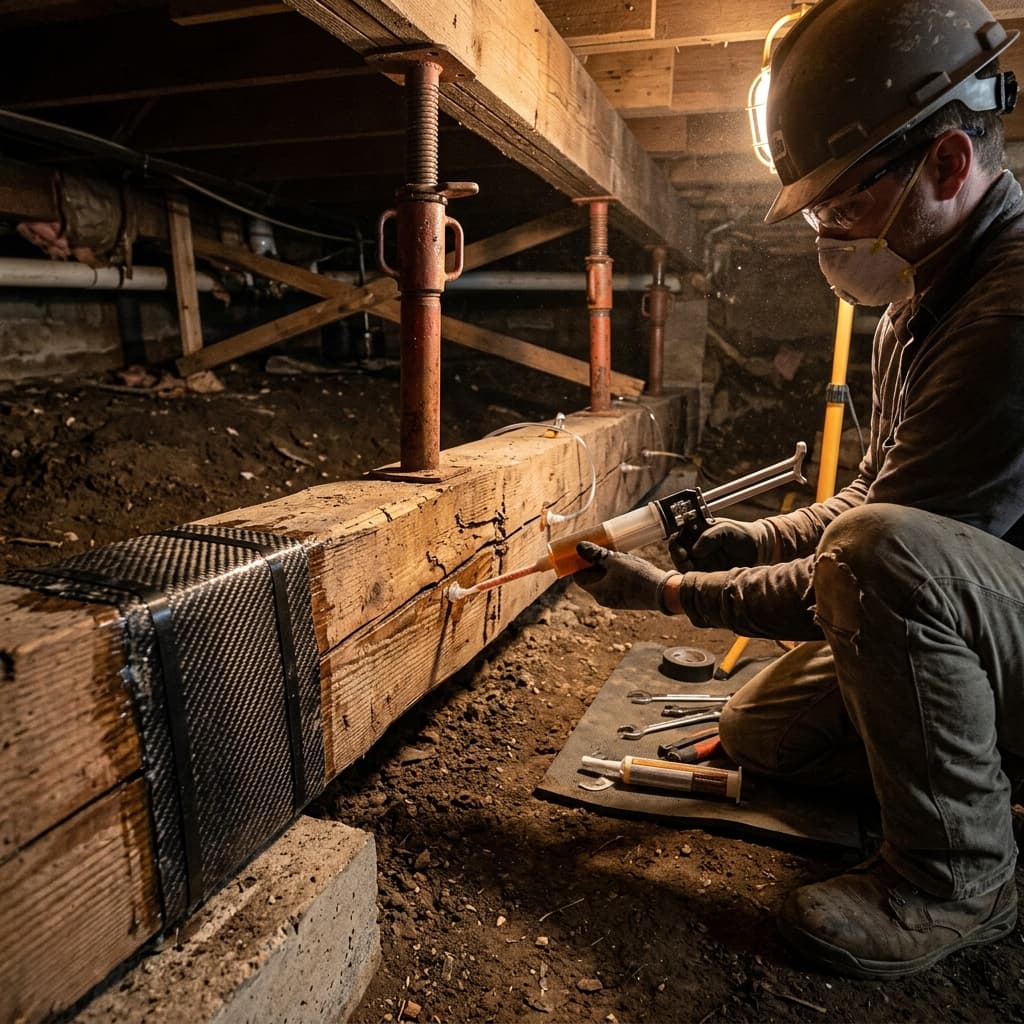
First, we scrape away the rotted material and treat the area with a borate fungicide to kill any remaining spores. Next, we seal the exterior of the beam and install injection ports. We inject a low-viscosity, structural-grade liquid epoxy or polyurethane resin into the ports. The resin penetrates deep into the wood fibers and cracks, curing into a solid mass that is stronger than the original wood and highly resistant to future moisture and pests.
2. Carbon Fiber and Fiberglass Reinforcement
To restore bending and shear strength to bowing or cracked load-bearing beams, we can wrap them in carbon fiber reinforced polymer (CFRP) sheets.
CFRP is incredibly lightweight but has a tensile strength ten times greater than steel. We apply a structural epoxy adhesive to the wood beam, wrap it in high-strength carbon fiber fabric, and apply a topcoat. This creates a rigid structural sleeve that prevents the beam from flexing or splitting under load, without adding significant weight or bulk to the crawl space.
3. Sistering and Shoring
If a section of a beam is completely rotted through, we must support the weight of the floor using temporary steel shoring posts. Once the load is safely transferred, we cut away the damaged section of the beam.
We then "sister" the beam by bolting new, pressure-treated lumber or engineered LVL (Laminated Veneer Lumber) beams alongside the remaining healthy wood. This creates a double-strength girder that securely transfers structural loads to the foundation.
Typical Repair Methods and Cost Comparison
The cost of structural wood repair in Los Angeles depends on the length of the beam, accessibility of the crawl space, and the repair method chosen:
| Repair Method | Typical Application | Lifespan / Durability | Cost Range (Est.) |
|---|---|---|---|
| Epoxy Injection | Localized cracking, minor dry rot pockets | 30+ Years (rot-resistant) | $1,500 – $3,000 |
| Carbon Fiber Wrapping | Bowing girders, structural reinforcement | 50+ Years (immune to rot/pests) | $2,500 – $5,000 |
| LVL/Beam Sistering | Moderate rot, cracked floor joists | 40+ Years (highly stable) | $2,000 – $4,500 |
| Full Girder Replacement | Severe, widespread dry rot or termite collapse | 50+ Years (rebuilt to modern code) | $6,000 – $12,000+ |
The PiersPro Promise: Integrity in Engineering
At PiersPro, we operate under California General Contractor License #1110475. We follow a strict "No-Upsell" policy: if a beam only has minor cracking that does not impact safety, we will recommend a simple seal or tell you it is fine. If a beam requires engineering and building permits from the local building department (LADBS or OC), we manage the entire process from drawings to inspection closeout.
We document our real-world structural repair and helical pier installations with photos in our Projects section. We believe in transparency and honest diagnostics.
Frequently Asked Questions (FAQ)
Q1: Can a termite-damaged beam be repaired with epoxy?
A1: Yes, if the termite damage is localized and has not destroyed more than 30-40% of the beam's cross-sectional area. We inject structural epoxy to fill the hollow tunnels, which solidifies and restores the beam's compressive strength. If the damage is more extensive, we will sister or replace the beam.
Q2: What is the difference between dry rot and termite damage?
A2: Dry rot is fungal decay caused by wood-decaying fungi and moisture; it causes the wood to darken, shrink, crack into cubic pieces, and crumble. Termite damage is caused by insects eating tunnels inside the wood; you will often see hollow chambers, mud tubes, or small exit holes with fecal pellets (frass).
Q3: How long does a structural wood repair project take?
A3: Most residential wood repairs—such as sistering a girder or injecting epoxy—are completed in 1 to 2 days. Larger projects involving full girder replacements under shoring may take 3 to 5 days.
Q4: Do I need building permits to repair a wood beam?
A4: Localized repairs like minor epoxy injection or sistering a few joists typically do not require permits. However, replacing a major load-bearing girder or column that supports the home’s primary framing will require building permits and structural inspections from the local city or county authority.
Protect Your Structure: Schedule a Diagnostic
Don't ignore the warning signs of sagging floors, squeaking joists, or musty crawl space odors. Catching wood decay early can save you thousands of dollars in structural damage.
Contact PiersPro today. Call us at (213) 583-6669 or book a free visual inspection online to evaluate your structural framing.